Scotty Reiss
Contributor
Published: Jul 15, 2022
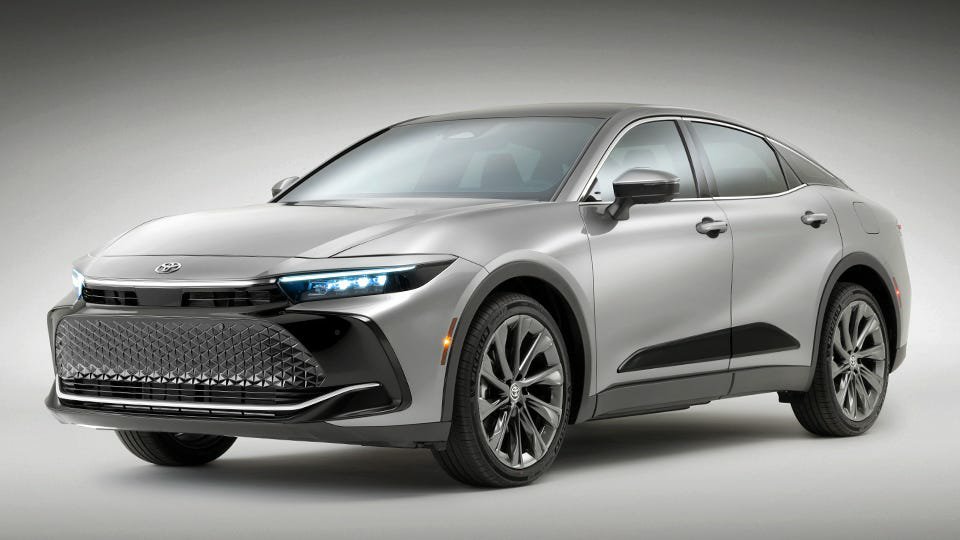
Past Toyota Crowns, although they haven’t been imported to the U.S. since 1972, have all been big luxury sedans, wagons or coupes, but the 2023 Crown is a 21st-century mash-up of crossover, fastback coupe and sedan themes. Scotty Reiss
On sale since 1955, the Toyota Crown is a big star in Japan and one of Toyota’s longest-running products. But while familiar all over Asia and one of the first products the automaker imported here, the big Crown hasn’t been sold in the U.S. since 1972. This fall, however, a hybrid-only Crown will return stateside as Toyota’s most luxurious model It’ll also be the first to get the automaker’s performance-oriented Hybrid Max engine.
Toyota hasn’t yet announced pricing, but this new Crown is very different from previous versions or the soon-to-depart Avalon. While a sedan with a fastback design, it may also be called a crossover for its higher ground clearance, 4 inches more than the Camry.
It is resultingly tall: The Crown’s overall height is 60.6 inches to the Camry’s 56.9, but it’s still shy of full crossover height: the Toyota Venza is considerably taller at 65.9 inches. Although we won’t see them here, Toyota has introduced three other versions of the Crown for Japan, a conventional sedan without the lift, a compact crossover not too different from the U.S. model, and a full-on SUV called the Crown Estate.
The last time the Toyota Crown was sold in the U.S. was in 1972, and it looked like this. The model has remained a conservative sedan ever since. Toyota
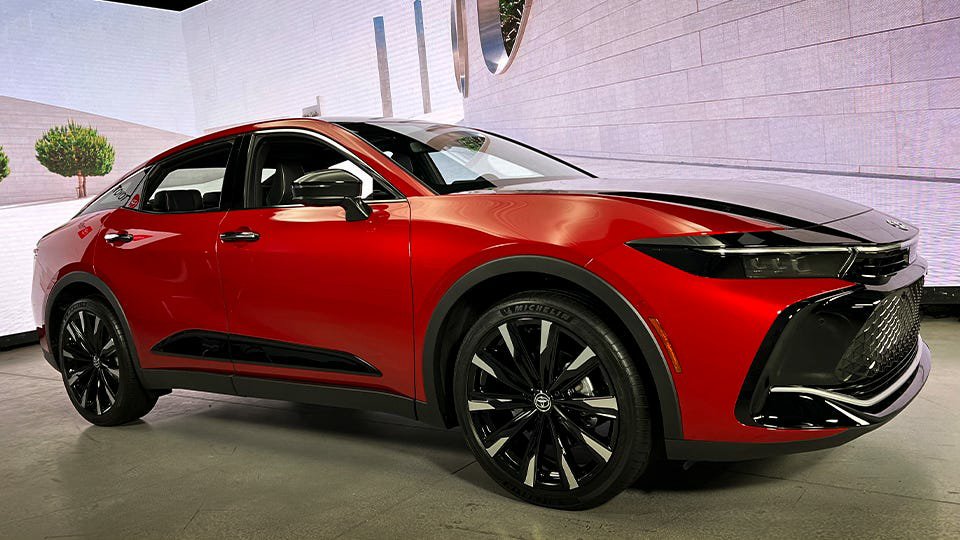
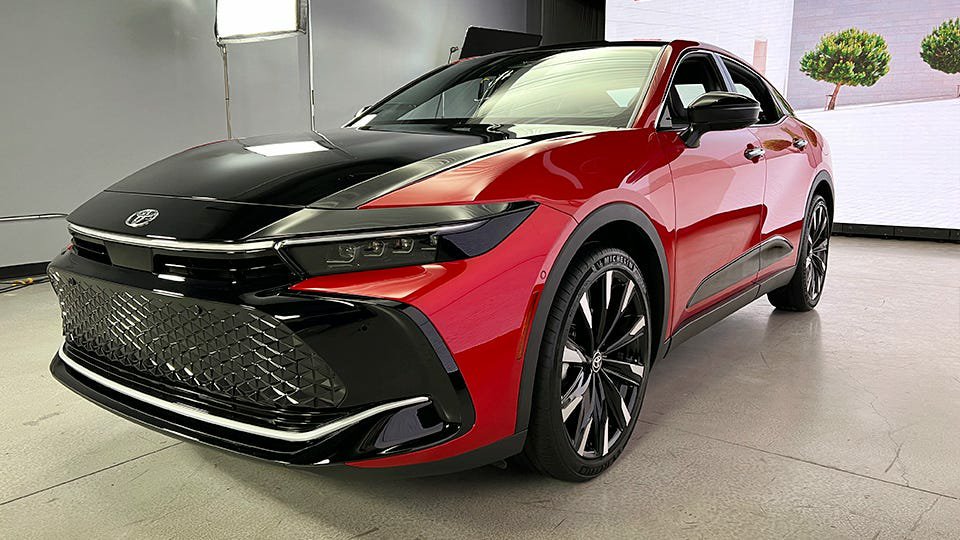
Until now, anyway. The fifteenth-generation 2023 Crown looks dramatic, particularly in this two-town black-and-red scheme. Scotty Reiss
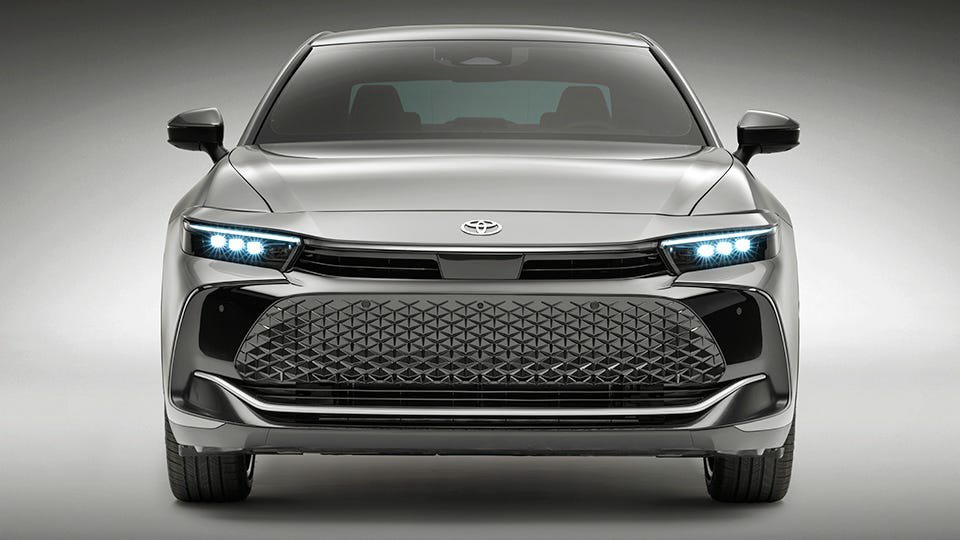
Designed and built and in Japan, the U.S.-model Crown won’t have the Maserati-esque front grille badge seen on global models. Instead, it has a unique front grille and facia anchored by a traditional Toyota oval. The front is marked by a flat front grille with a diamond cut pattern but no perforations as is typical of internal combustion engines; instead it has small, horizontal air intakes above and below the grille.
A Roomy, Comfortable Back Seat and a Large Trunk
The luxury continues in the backseat, which is wide and comfortable. Rear seat passengers will find air vents and USB-C ports for charging devices. Despite the coupe-like shape of the Crown, there’s plenty of headroom for an average-height passenger.
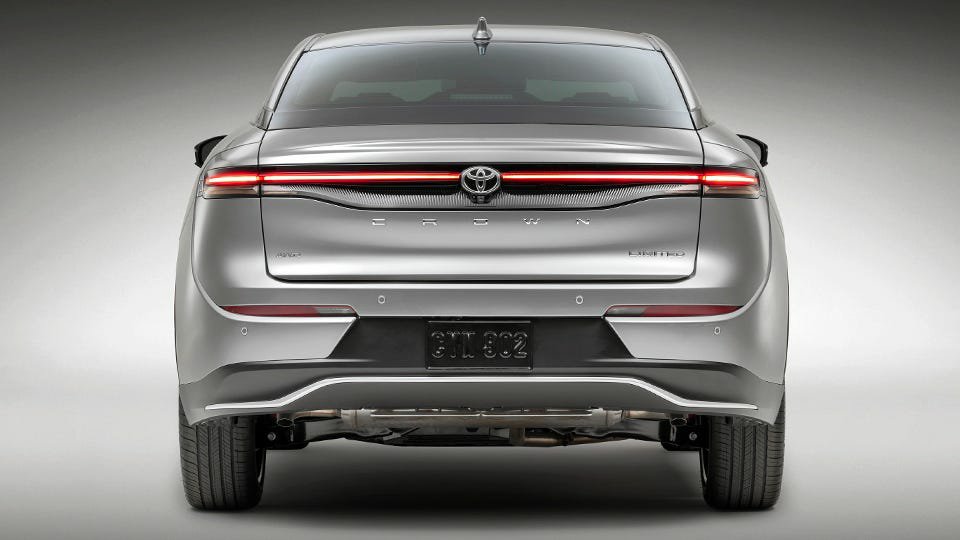
The coupe shape, however, might lead buyers to think that this is a hatchback with contiguous passenger-cargo space. It isn’t. Instead, and a bit like the Tesla Model 3, the Crown has a traditional trunk, which is quite large, though the rear seats fold to create extra linear cargo space.
In all, Toyota brings some great new details and luxe features to its top-of-the-line model, a natural re-introduction of the Crown name. The promise of Hybrid Max will no doubt delight the more lead-footed drivers on the road, and for those who want better fuel economy, Toyota delivers its always reliable hybrid system, now in a more luxe environment.
Prices will be announced closer to the Crown’s on-sale date, but expect it to reach dealers in the fourth quarter. The automaker says the new Crown is not specifically a replacement for the outgoing Avalon, but it will sit at the top of its car lineup, so expect prices to start somewhere north of $50,000.
provided an update on the conversion of the Emden plant for the production of MEB electric cars, which started in July 2020. Completion is scheduled for the first half of 2022, with EV volume production to begin with the ID.4. VW has also confirmed other models, including an electric estate.
After the electric SUV, which will also continue to be manufactured in Zwickau for the European markets in parallel, the fully electric series versions of the ID.Vizzion and ID.Space Vizzion show cars will also come off the production line in Emden from 2023. These are a sedan and the accompanying estate car the size of a Passat. The sedan study was unveiled in 2018 with a 111 kWh battery (for 650 kilometres of range according to WLTP), while the station wagon study shown in 2019 featured the familiar 77 kWh battery.
Incidentally, the Passat and the related Arteon and Arteon Shooting Brake models will continue to be built in Emden “in a transitional phase lasting several years”. Later, however, Emden is to become a pure electric car plant.
Six new production halls and logistics buildings are being built for the production of electric vehicles. For the production of the MEB electric cars, among other things, a 25,000-square-metre body construction hall was built within ten months (called Hall 19), in which about 450 pieces of equipment will be used. From there, it goes to the plant’s modernised paint shop, which among other things, has been expanded to include a “bi-colour hall” – where the optionally black-painted roofs get their colour. A new hall of around 60,000 square metres houses the final assembly of the MEB electric cars and a battery warehouse.
With the transformation of the Emden plant, VW will train all of the approximately 8,000 employees at the site for electromobility. “The transformation to e-mobility is becoming more and more concrete in Emden. Since the beginning of the transformation, the Emden Volkswagen workforce has done a great job,” says VW Board Member for Production Christian Vollmer during a site visit. “The entire plant has developed rapidly. We need this commitment because Emden is an important location for our brand’s electrification offensive.” Emden is becoming an innovative e-plant with state-of-the-art and, above all, environmentally friendly production, Vollmer said.
Plant manager Uwe Schwarz states that there has never been a comparable conversion in Emden before. “In addition to building new halls, we are already converting the first processes, preparing for the start-up of the ID.4 next year, and all of this while the plant is still in operation: the existing body shop is currently producing the first individual parts of the ID.4 for testing and running in the equipment,” says Schwarz. “In addition, start-up workshops and production-related qualifications are already taking place.”
In addition to the revamped MEB plant in Emden, Volkswagen has commissioned the expansion of its press shop at the Zwickau electric car plant. From now on, the entire outer shell for the six electric models produced in Zwickau will be pressed on-site. From now on, this will save more than 9,000 direct truck journeys for body construction and thus 5,800 tonnes of CO2 annually.
Toyota has been slow to the fully electric game, only just introducing the bZ4x crossover earlier this year. But last doesn’t mean worst, and with the introduction of the Crown, it appears that Toyota is poised for a more studied entree to the electric car market.
Toyota defines hybrid as part of its electrification strategy, but the Crown carries earmarks more typical of fully electric cars: The size, shape and height of the chassis, the flat front grille and the relatively flat rear floor with only a small driveshaft tunnel are details commonly seen on electrics.
Luxury Details, Including Some that Migrate from Lexus
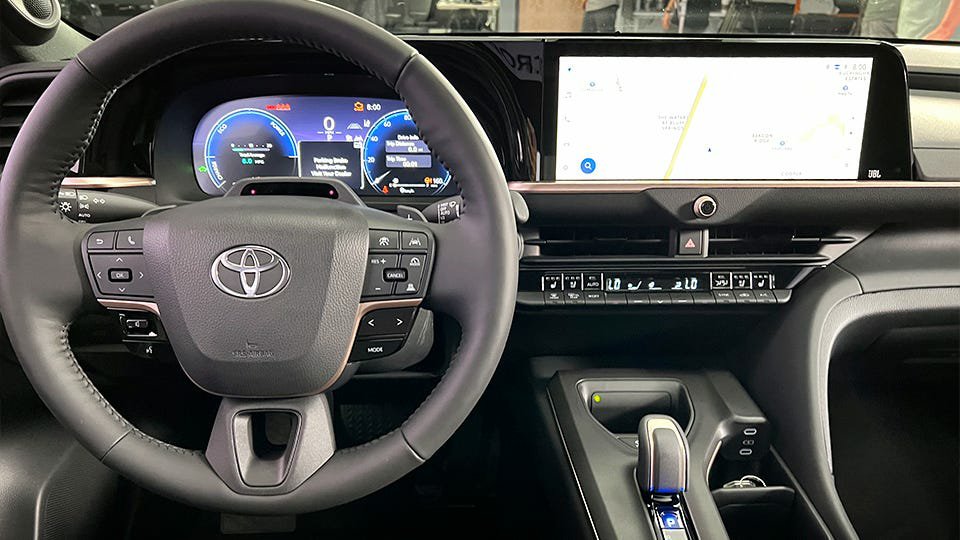
Sitting in the driver’s seat, the luxury details of the Crown are apparent; Toyota’s leatherette, called SofTex, covers the seats (with a faint bronze-colored contrast piping on the Platinum model we saw) in an elegant channel stitched pattern, and soft-touch materials cover all surfaces. A new minimalist design for the center console and dashboard add to the elegance. And some first-time features for Toyota make their way from Lexus.
 Hennessey Garage
You must be logged in to post a comment.